The immediate situation is a little to engrossing to allow most of us facing it the opportunity to think about such things, or mourn the victims of the bombing, if we wanted to. Birzeit University's classes were officially suspended in the wake of the bombing as travel to the university from Ramallah and beyond became progressively difficult.
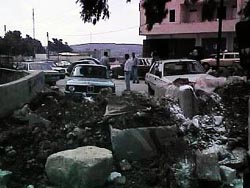
Over 3,700 students are now sitting around thinking ugly thoughts about the Israelis. To get here over the last few days, I had to take a taxi to the edge of Ramallah, climb over a pile of bulldozed earth and concrete (left), and catch another taxi from the other side to Birzeit.
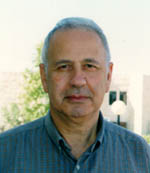
I had spoken to "Captain Colin", the Israeli commander of the Ramallah area at the end of the day on the 5th, when he phoned to follow up a report that the university president Dr. Hanna Nasir (right: © Yasser Darweesh) was "stuck at a checkpoint" and if I had his mobile phone number.
We tried Arabic for a while but realised English was a safer option. Before news came to me that he had got through, eventually, I asked Colin when the closure was going to be lifted. "Hopefully soon," he said, sounding more than a little tired, "it is better for you and it is better for me."
Dr. Nasir's checkpoint saga later became a story all of its own. To cut a long story short, a soldier treated him as less than human.
Here is a man whose family committed their lives to build an educational institution where there was none, and who willingly handed the control, land and physical property of the institution over to an autonomous board of trustees when it became a university.
The grateful Israelis, who have repeatedly claimed to have "set up the Palestinian universities", deported him for 19 consecutive years. They also shot 16 of the university's students in a variety of situations, mainly demonstrations, and shut the university 15 times by direct military order "for security reasons", the longest closure being 51 months.
I suppose the kindergartens were also shut down for "security reasons"? A five-year-old, when he or she is a Palestinian, is clearly dangerous. Never mind that they still treat us like criminals at the airport when we are leaving the country. Don't you think the university and its officials might deserve just a little respect after all that? The journey to work is bad enough...
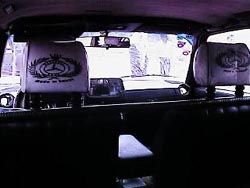
The closure has seriously affected local transport-related business. The local taxi drivers, who have already suffered over the last couple of years from the denial of permits for their former Ramallah-Jerusalem-Ramallah route, really have gone nuts over the last week. Forced to drive on narrow back roads, unpaved building sites and fields, in the effort to find a way to continue to transport people along the much shorter Ramallah-Birzeit-Ramallah route.
Occasionally the drivers will start screaming inside the taxi at another driver, coming his way along a narrow steet, each playing a two miles per hour version of "Chicken" that - after the required reversing and scooting over to one side - inevitably leaves even the victor stressed and angry. Many people prefer not to take the trip and, since the university suspended the academic programme, even the students and staff who were able to get there - with some difficulty - have stopped using the taxis.
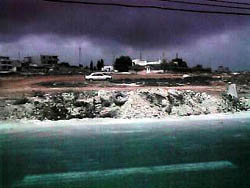
Travelling across an open field in a car, only meters away from an Israeli-patrolled road, when you know the Israelis have just spent that particular day making a concerted effort to seal Ramallah, and have even manned these dirt and concrete barricades, can be interesting.
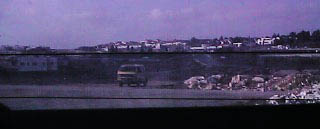
A possible bullet in the head can be quite an influential reason to stay at home, especially when the route you are taking follows so close to Beit El settlement, in this case a short way away on the opposite side of the road, where this digital photo on the right was taken.
Who knows what might happen as you criss-cross back and forth across a field to avoid pits and humps, your driver yelling above the noise, "You see what our life is like? You see what our life is like?" I was cheered by the sight of another van behind us, between us and the settlement. At least he'll get it first, I thought.
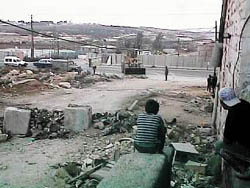
Perhaps the most ironic sight was that the bulldozer that was sealing the roads was being driven by a Palestinian, watched over by a jeep and soldiers and a group of bemused Palestinians (left).
Whether he had been forced to or not, I don't know, although I suspect he was an Israeli Arab working at the settlement, as the watching Ramallah Palestinians were looking on with disgust rather than sympathy.
"It's a Palestinian sealing us in," shouted one guy, laughing like a madman, who I guessed lived near the barricade, "a Palestinian!"
Considering that it was largely Palestinian labour that built the settlements thanks to the miracle of Israeli-inspired economic dependency, this was nothing new, but somehow the strange contradictions of this reality remain to disturb.