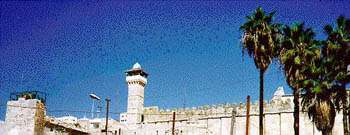
On Monday 7 November, Khalil Al-Rahman Mosque in Hebron (above), part of the religious site known to both Jewish and Muslim worshippers as the Tomb of the Patriarchs, reopened, more than eight months since its closure following the February tragedy of the Hebron massacre.
The real test that many commentators were waiting to see was how the Israelis would administer the delicate new arrangements relating to the partitioning of, and admissions to the Mosque on the first day of Friday prayers. Prior to the massacre, between 4,000 and 5,000 Muslim residents mainly from Hebron's city population of 120,000 would come to worship on a Friday.
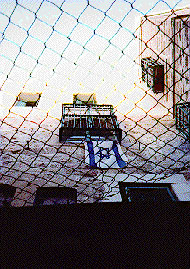
Left: 400 Jewish settlers live in the heart of Hebron's Old City.
The chainlink fence above this shopping alley was errected to protect the Palestinians from settlers throwing stones at them.
In places, the netting is covered by rubbish the settlers have thrown down from their homes, a measure of the contempt they show for the Arab inhabitants of the city.
The Tomb of the Patriarchs used to be partitioned so that the Palestinian population had access to 90 percent, the Jewish settlers allotted the remaining 10 percent.
In the end, it was announced that the new partition plan, in a manner not unknown to those familiar with the Israeli-Palestinian conflict, gives the 400 Jewish settlers resident in Hebron and the 1200 Israeli soldiers that guard them, 55 percent of the entire structure, including - of course - sections that used to be part of the Mosque, leaving the 120,000 Muslims with 45 percent.