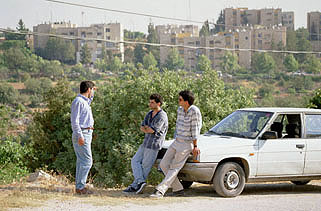
Adli takes us round past Kiryat Arba, where he and his wife Dina's family both own land. Over the years, the settlement has swallowed up more and more, until there is none left. The story is quite representative as stories go, and deserves mention. A court case appealed the last confiscation of land, on which settler houses had already been built on both sides of a small road.
The judge agreed there was a problem but then returned a bizarre verdict saying that settlers could live in houses on the side of the road nearer to Kiryat Arba, while the houses on the other side could only be resided in by the Israeli military.
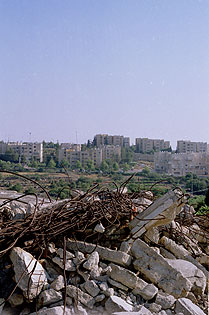
After driving past this area, Adli parked the car to tell the story (above). Round the next bend, the ruins of a demolished house were visible, ironically against the back drop of Kiryat Arba settlement (below). A family had lived there, until the Israelis destroyed the house after one of their sons participated in a military operation against Israeli soldiers.
This is a not-uncommon phenomenon, supposedly a deterrant to any youths planning to take up arms against their oppressors. In the Intifada period, family houses were actually demolished if their kids were caught throwing stones.
Imagine the outcry if the family of Timothy McVeigh, he of Oklahoma bombing fame, had seen their house destroyed after the court had found him guilty. It would totally contravene the legal principle that you are accountable only for the crimes you yourself commit.
Did the family of Yigal Amir, the Israeli student who assasinated Prime Minister Yitzhak Rabin, see their home demolished? No. Well, it happens to Palestinians here - who have done a lot less - on a regular basis.
Recently, there have been a spate of house demolitions in the Jerusalem area, on the pretext that they were built without permits. The fact is that permits are almost never granted to Palestinians, an attempt to force them to leave Jerusalem in order that the State of Israel can point to higher numbers of Jews in the city as a basis for claims of sovereignty.
The story of Jerusalem is a sad tale of Israel's fondness for apartheid laws to remove residency rights, racist housing policies, boundary gerrymandering and a variety of other distasteful manifestations of ethnic cleansing.
In the case of house demolitions for example, Jewish home extensions are not being destroyed for the lack of a permit and indeed are often granted them retrospectively. In 1992, there were 2,019 cases of illegal construction in (Jewish) West Jerusalem and 226 in Arab (East) Jerusalem.
In 1993, there were 1,509 and 361 cases respectively. Most of the West Jerusalem cases involved floor space (usually with a commercial emphasis), demolitions taking place only of fences and windows, and certainly not of Jewish family homes and businesses.