Kathy Kern, who has been following the situation with the soldiers down in the street below, through a window, gets up at one point and announces that she is going downstairs.
"They're stopping every single person that passes, let's go down."
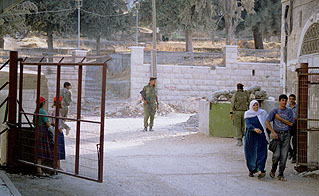
Donning a red baseball hat and accompanied by another CPT member, they disappear out the door. I follow with a camera, and stand outside the door as they approach and stand across the narrow street from the two soldiers (left). The group of people are released.
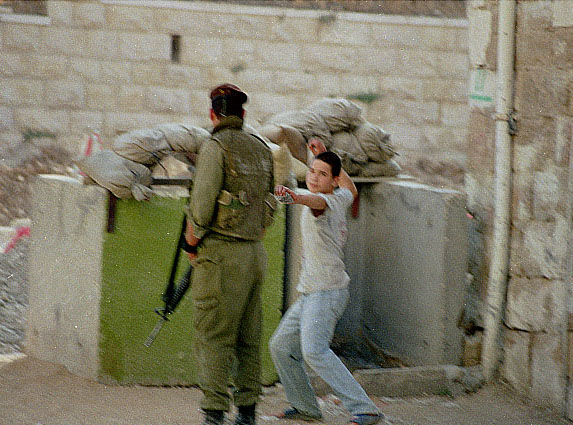
An 12 or 13-year-old settler kid turns up and starts talking to the soldiers. I am still photographing. The kid suddenly bends down, grabs a stone and throws it at me. I turn my head away and protect the camera while it whizzes past me and then stand and look back in disbelief.
The soldier turns round and half-heartedly says something to the kid, who answers him back and proceeds to ignore him. The kid has picked up more stones but this time I myself am ready when he tosses them at me.
I snap his photo in mid-throw before again turn my head away (right, click for 90K enlargement). The kid's face is cold, showing no emotion. The soldier does nothing and looks at me with curiosity to see what I will do. It seemed initially that he was concerned that I would react but is now standing there, smirking, holding his gun.
I am fighting a feeling of unreality, although satisfied that I just got a very interesting photo. I return inside and leave the CPT to it. There is always a danger that soldiers will try to confiscate your film.
All I can think of in my mind as I climb the stairs is how Israeli soldiers shot dead a 16-year-old Palestinian child in Beit Sahour last Monday, for throwing stones, when there was not even a demonstration taking place or, according to Beit Sahour residents, was not even throwing stones at the time.
George from Beit Sahour, who has appeared in previous diary entries, told me the story after I read about it. Whether the child was even throwing stones half-an-hour earlier with a group of 10 or so kids is not sure. What is clear was the way in which he was shot.
He had gone to a house to ask for a glass of water, and was sitting in front of the house afterwards, when two soldiers arrived. They shot him in the head from across the street as he was sitting there, and then left.
We thanked the CPT members and left after another 15 minutes. Kathy told me that she had asked the settler kid why he had thrown the stone. "I didn’t want my picture taken," he had said.
We say goodbye to Adli and Ramzi and set off through the Old City. A lot of thought and feelings are boiling around inside. Adam saves my psychological day by asking exactly what had happened with the settler kid, forcing me to articulate it. I told him that I have often heard how settler children walk through Hebron market, under the guard of accompanying Israeli soldiers, and overturn vegetable carts and otherwise harass Palestinians with impunity. I had never seen it before and the reality is always worse than the story.
I realised that my hands had been shaking as I had returned upstairs to the CPT home. Shaking with fear. Not fear of the soldier or fear of the child or his stones, but fear of the boundaries crossed. What other country in the world could children behave with such disrespect without being cuffed behind the ear by an adult and sent home?
"Palestinian children throw stones," points out Samira, the Devil's advocate. "True, I replied, but it's a different thing when a child in a country under military occupation confronts an armed man. Here we had a child of the side with power, whose behaviour at 12 or 13-years-old shows both a knowledge of that power and a normally-appealing, childlike trust in his right to it.
I remembered Oliver Stone's Wild Palms, with its nihlistic vision of a future where virtual reality had become reality, and where the children seduced by this technological fiction sadistically torture and murder adults. That’s why what I witnessed was frightening. The amoral and deliberate ignorance of restraint in a child and the lack of understanding by the adult present of the consequences of allowing this to continue, unfettered.
We get stuck at a checkpoint in the Old City again. Actually we walked though the first barrier before the soldier noticed us and then brazened it out.
"You can't come here," he says. Refusing to accept this non-starter, Adam and I repeatedly ask him why.
"There was a bomb," he replied, "you can't come though here." We gaze around at the deserted area, about 30 square metres. I smile.
"Did it explode?" I ask.
"Yes," said the soldier.
We look around slowly again, at the perfectly un-bombdamaged area, both trying not to laugh.
"Can we go through then?" The soldier asks a commander down the street and finally says okay. Just another day in occupied Palestine. The government and scientists that are spending so much time, money and effort sending dune buggies to Mars to search for life on other planets, should consider letting one stop-over in Hebron on the way back.
The white van taxi on the way back stops at a checkpoint. By the side of the checkpoint, around 15 Palestinians, presumably West Bankers who were committing the crime of trying to pass through Jerusalem to get home, have been made to wait by the side of the road (photo coming). I give the soldier who checks our passports a photocopy of it and a paper from the British Consulate in East Jerusalem, saying that it was lost and that a new one is currently being processed, explaining this at the same time. He looks at it for a painfully long while before speaking to me.
"You lost your passport 3 years ago?"
I take the paper back off him again and look at it. "No, that’s the date of issue of the passport," I tell him. Adam is grinning uncontrollably.
As we pull away, the van driver is laughing. "He can't read English!" he says to us all in Arabic, laughing, "He can't read English!" I smile. The final curtain to the day was passing the formerly forested Jebal Abu Ghnaim on the way back through Bethlehem, since shaved by Israeli bulldozers. It's the first time I've seen it since this happened and I'm sure I'll see the same process happen many more times. "Welcome to Israel!"