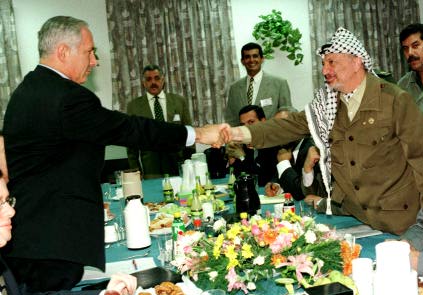
We had been waiting for the Hebron redeployment for a long time just as we had waited for Netanyahu to shake Arafat's hand for the first time (left, AP Photo).
It was supposed to have been completed by 28 March 1996, but a wave of bus bombings in the months before the Israeli elections gave former prime minister Shimon Peres cold feet at the crucial point of this, the most sensitive redeployment of all of the Palestinian towns. The same wave also swept Netanyahu and Likud into power.
The delays in the Hebron redeployment after the May 1996 Likud victory were for a different reason. Netanyahu's voter base was very much linked to the Jewish settlers in the West Bank and Gaza Strip.
They voted for him en masse, seeing him and others in his party as a staunch supporter of their cause, having done so much for settlements during their previous time in office.

For Likud, increasing international anger at its fundementally anti-Oslo stance and its own desire to retain the economic benefits of a peace that brought Israel back from the cold fringe of the international community, made facing Oslo inevitable, at some point.
A US official was quoted in the Jerusalem Post of 17 January 1997 as saying:
"The tunnel and the violence was a wake-up. Until then, [Netanyahu] was playing around with the Palestinian issue. He was not serious about it. The Palestinians felt disillusioned, were being used for photo-ops, deflecting pressure from the Europeans and Arabs. There was no movement on any issue, and the Israeli bureaucracy was instructed to avoid contact with Palestinians."
The Israeli government, in the form of the Israeli Ministry of Foreign Affairs, managed to turn the issue of Hebron's delay back on the Palestinians. In one offering from its website, http://www.israel-mfa.gov.il/news/oct1996.html, it goes into great detail reproducing a variety of opinions from "experts" to show that, really, the tunnel opening was no big deal and how the Palestinians "used" the issue as "an excuse". In fact, the Ministry goes as far as to say that:
A major cause for the delay in the negotiations was the egregious* violation of the DOP and the Interim Agreement by elements of the Palestinian Police who opened fire, without provocation, on IDF and Border Police units as well as on Israeli civilians. The tragic events of this past September not only hindered the negotiations, but also underscored the need to fashion carefully an agreement which would enhance security in Hebron and minimize conflict, incitement and violence.So the frustration and anger felt by the almost three million Palestinians at the new Israeli government's delay of the peace process, that exploded into expression at the September 1996 opening of the newly-Judaised, latest fact-on-the-ground tunnel, was conveniently misrepresented as the reason for the lack of progress in the negotiations! Which came first? The dog or the egg? For those that still haven't read Birzeit University staff reports on the September/October events, with the facts about who opened fire on who first, and the facts of the "unprovoked" assault on the poor Israeli soldiers, check out the "On the ground in Ramallah: Reports from a town become battlefield" website at http://www.birzeit.edu/palnews/war/ and, in particular, the photo section, an updated version of which is now part of this diary.
*meaning "flagrant". Quoted from The Hebron Protocol in the Context of the Peace Process, Israeli Ministry of Foreign Affairs, January 15, 1997.
By the way, note also that "Israeli civillians" were opened fire on during the September/October clashes. Translate this as "armed settlers" who also were opening fire on Palestinian police in some areas.
Whatever the case, Netanyahu's statement to the Knesset today about why he eventually decided to redeploy after amending the Hebron agreement as it was initially conceived in the Oslo 2 document, bear some scrutiny.
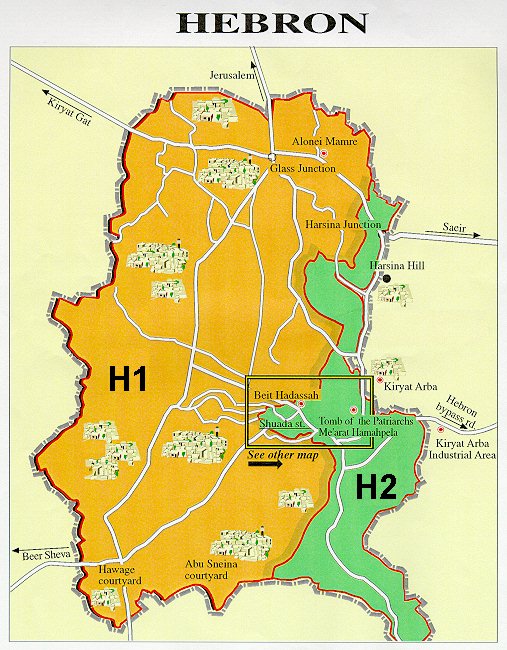
Oslo 2, or the "Interim Agreement" was signed in September 1995, containing a separate section entitled "Guidelines for Hebron" (Security Annex 1, Article VII), which delimited two types of area in Hebron: H-1 - where all responsibilities are to be transferred to the Palestinians and H-2 - where security responsibilities are to remain in the hands of Israel. The Palestinians have municipal and civil responsibility throughout the entire city.
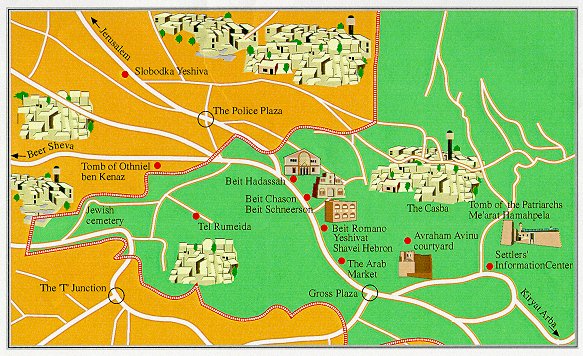
If you look at the H-1/H-2 map of the city (101K) H-1 basically covers all the west and some of the east of the city. H-2 covers part of the east of the city, where the main Jewish landmarks can be found along with the 400 settlers and 25,000 Palestinians, available on a more detailed map (86K). Kiryat Arba with 6,000 residents, lies just outside the center of Hebron in H-2.
What Netanyahu did was to hide the unworkability of keeping 400 extremist Jews right in the heart of a city of 120,000 Palestinians, to a complex modern artform. The type of artform that, on seeing it in a gallery, you comment, "It's amazing, it must have taken a lot of thought and hours of construction." And then you pause for a minute before sighing and saying, "Shame it's so ugly."
By burning the sacred cow of Hebron settlers by handing back most of the city to the Palestinians, the sacred cow whose mantra is that the city is somehow fundementally Jewish and if the settlers only stay there long enough, the 120,000 Palestinians will get bored and move to Jordan, Netanyahu desperately needed to achieve three things.
He needed to (i) excuse the deal "inherited" from the former Labour government, (ii) present it as consistent with his "Peace with Security" slogan, and (iii) affirm the Jewish settlers there. He managed all three very competently.
The latter is the one that interests me the most. What did he say to these few hundred individuals, from whose midst Baruch Goldstein rose to murder Muslim worshippers, those individuals who later constructed a shrine at his grave in honour of his deeds, where they continue to pray today?
What did he say to those whose Rabbis have been known to shoot Palestinians in the city? What did he say to those who empty their rubbish from their settlement windows high above the Old City onto Paletinians below? What did he say to those who, under guard of Israeli soldiers, encourage their children to overturn Palestinian vegetable barrows in the market knowing that no reprisal will follow?
This is what he said:
"We do not want to remove the Jewish community from Hebron. We want to preserve and consolidate it. We do not want to remove ourselves from Hebron; we want to remain in Hebron... I would like to appeal to the [Jewish] residents of Hebron. I know that you are fearful today, and I would like to say to you, brothers and sisters, that we are concerned for you, that we do not see you as an insignificant appendage. We see you are dear brothers. We are concerned for each and every one of you. We do not see you as 400 insignificant Jews, but as our representatives."The phrase, "I couldn't have said it better myself," springs to mind. Let's have a closer look at this "community".