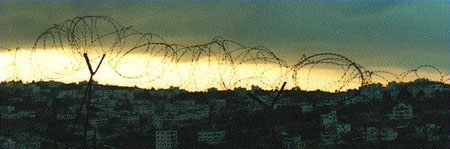
I arrived in Hebron, al-Khalil ("the friend") in Arabic, at around 4:00pm on 17 January, the redeployment having taken place 10 hours ago, at a rainy 6:00am. Adli, who works in our office and lives in Hebron was to meet myself and Kifah at the petrol station in the center of town. Kifah had thought I was crazy to come down here.
"It's Ramadan!" he pleaded desperately, "We won't be able to smoke or eat all day long!" The necessity of viewing the march of history won over and we came a tortuous route from Ramallah, the last leg in a coach filled with Hebronites returning from praying in al-Aqsa Mosque Jerusalem.
As we had approached Hebron, the bus driver's son, standing before the front bus window, was suddenly framed by the appearance of one of the many settlements along the road from Bethlehem, looming behind him. It's European-style houses and sheer size made it a shocking feature on the rocky hillside. I've seen it many times before but each time it still has the same effect on me.
After meeting Adli, we took off in his car for a quick tour of the city. It is huge, the biggest in the West Bank, with over 120,000 Palestinians living in the tens of thousands of houses sprawling over the hills. With the Negev desert in the south, Hebron is cold in the winter, even the kind of winter we've been having this year, with 19° centegrade registered in Ramallah on Christmas Day.
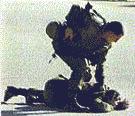
Hebron is a conservative Islamic city, known for the violence that regularly sparks up between its settler and Palestinian residents. New Year's Day this year witnessed Noam Friedman, from one of the settlements north of Hebron, walk into the market and open fire on Palestinians, before being pinned down by Israeli soldiers (right). His interview with Israeli TV says it all for the stormy relations between Arab and Jew in this area:
Israeli TV: Why did you do it?
Friedman: Because Hebron always has been ours and always will be.
Israeli TV: You don't regret it?
Friedman: No.
Israeli TV: Who gave you the gun?
Friedman: The army.
Israeli TV: Are you sure you're normal?
Friedman: Yes, completely normal.
Israeli TV: Killing innocent people?
Friedman: They're not innocent. they hate the Jews.
Israeli TV: Children, women?
Friedman: They hate Jews.
Israeli TV: So you're not sorry?
Friedman: No.
Israeli TV: Do you think it will harm the country?
Friedman: No, it's good for the country.
Israeli TV: But people say it will harm the Jewish settlement.
Friedman: So? They say it.
As we drove around, I couldn't help but wonder if what we were seeing was another sunset on the Israeli occupation or a new dawn of its legitimisation. The Hebron Protocol basically recognised the occupation by assenting to a "Jewish" area approximately 20% of the city's size, in which 25,000 Palestinians live. The same number of Palestinians as there are in Qalqilia, which the Israelis handed back to the Palestinians in 1995.