|
It was around the end of February, beginning of March in 1988. There were three days of continuous clashes, day and night, and all of the young people went into the streets. During these times, you cannot go home as the soldiers might advance into the village and scatter the people left there. If you were at home, you wouldn't know what was going on and it would be easy for the soldiers to catch you. However, if you are with the demonstrators, you can see what is happening and know where to run if they move anywhere. You are left in the strange situation where it is safer to stay on the streets with the demonstrators than to stay at home! I remember one guy, who now works for the Palestinian Authority, in the Jenin branch of the Ministry of the Interior. We were there together at that time, and the clashes were going on and on and on. Soldiers were maybe 50 metres in front of us. We had stayed put since the beginning of the clashes and were really hungry! Someone went and got some biscuits and handed them around. So, there we were, with stones or empty bottles in one hand, and biscuits in the other! We would throw a stone or two, and they would get out the way. They would fire some rubber bullets, and we would duck. We would chew on some biscuits, throw a couple more stones and so it continued on. The soldiers were looking at us like we were mad. You could just see them thinking, What are these guys doing? They're standing there throwing stones and eating biscuits! The Israelis were surrounding the village during this same series of demonstrations. At night, we organised ourselves to work in groups. One group would have to take care of this area, one group would have to take care of that area, another to bring supplies, some to patrol several areas. Some were assigned to check exactly where the soldiers were situated. We figured that a seige could not be a perfectly-sealed circle. They wouldn't station one soldier every ten meters. It would be safer for them to have bases of ten or fifteen soldiers every hundred metres or so. So, I took a group of seven or ten guys to check their locations on one side of the village, down a forested valley. We spread out in a line, three metres between each of us and began making our way down the valley. We kept going and going until we were almost at the end of the trees, where there was a road. About ten metres along the road, we noticed soldiers based there and were glad to see they weren't close to the village. We were sitting there, making signs to each other that it was time to go back, when a platoon of soldiers appeared, running in the towards us and coming from the village. We had past them as they were trying to break through our lines, when a bunch of the guys from the village had begun chasing them. So here we were, trapped between a bunch of soldiers on the road and another bunch running towards us from the village pursued by our friends, who were chasing them with stones and molotov cocktails. It wasn't that we were afraid that we would be caught, we were more afraid that the guys would stumble on us in the dark and and start throwing the molotovs at us! We froze, motionless, and crouched behind bushes and tree stumps, as soldiers ran right through our group. We hid for a couple of hours, not daring to move until we were sure that everyone had gone home, when we sneaked back into the village, freezing. There is a road that comes from Haifa and Afula and passes through the northern part of the West Bank to Nablus that Israelis call in Hebrew "Trans-Samaria", 'Aabir As-Sammera in Arabic, although we call our part the "Jenin-Haifa road"). It used to always be full of settlers and soldiers driving to and fro. Our village is very near this road and all the demonstrations used to focus on it. We would block the road and within minutes of the first car finding it impossible to pass, lots of soldiers would appear. Then the demonstration would begin. The road from our village that joined the settler road was uphill, and both this and the stones we would use to block the road gave us plenty of time to get away if they came for us, because they would be forced to do it on foot. |
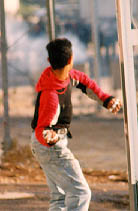
"What was it like to be in the middle of clashes, to throw stones at soldiers?"
Stone thrower in Ramallah, 1997. Photo by Nigel Parry. "It felt like madness, but it was necessary madness!" "You couldn't not do it. You had to do something and stones were the easiest thing to get your hands on." "You would only start to remember what happened when it was over. You would talk with other guys afterwards and you realise that what you thought you saw you didn't, because another 20 people saw something different happening." |
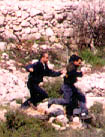
| This one time they brought a special jeep with a shovel in front of it, like a snowplow, and there were not enough rocks on the road to stop it. We saw it driving very fast towards them and, suddenly, it was as if the rocks weren't there. Nothing seemed to stop it! All the guys started to run. I was running as fast as I could and then I notice that the soldiers' jeep is passing me. Here I am, thinking, You are supposed to be chasing me to catch me! If you're not going to catch me, what am I running for? So I stopped running and just began walking. Other cars behind this one are coming and also passing me. I'm just thinking, So, why did you come?! You came to stop a riot but you're not paying attention to the rioters! |
![]() Above: Birzeit student stone-throwers fleeing from Israeli soldiers in 'Atara, near Birzeit town, 1997. Photo by Nigel Parry. |
|
On another occasion in the same location, about 10 months after the start of the Intifada, we had blocked the main road near where it intersected the settler road, put another block on the road up to the village, and then a final block at the top of the hill, where it turns a corner into the village. The soldiers would only be able to follow us on foot, which made it easier for us to get away, and generally the soldiers would never go for this unless they were sure of what they were doing. The narrow streets in villages and refugee camps are much harder to catch people in than cities, especially when chasing people who know the area well. This particular time, they drove up towards us and broke through the first and second road blocks, including the one on the road up to the village. They got right up to the top of the hill and turned the corner, where there was the final block. Stones and bottles from hundreds of people began to fly from everywhere, raining down on them in an open top jeep. They had to get into reverse quickly but got stuck and so leapt out of the car and ran back down the hill. We had their car! We turned the car round, fixed the steering with rope, set it on fire and sent it back, watching it slowly rolling back down the hill towards the rest of the soldiers, who freaked out and ran back. I guess they had seen a lot of movies and thought it was going to explode but it must have had diesel in it or something. We saw it a few days later by the side of the road. It was completely destroyed, with even its four tyres were totally burnt away. |
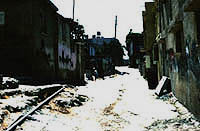
Above: The narrow streets of a West Bank refugee camp, 1989. Photo by Nigel Parry. |
|
Another time the soldiers, for some reason, forgot one of those white trucks that brings supplies of ammunition, tear gas, and rubber bullets during demonstrations. They couldn't stop the demonstration so decided to retreat, waiting for an armoured personnel carrier used by the mishmar ikvul (Hebrew, "Border Guards"), leaving the ammunition behind. We went up to it and found it full of tear gas grenades and ghaz khanik (Arabic, "asphyxiating gas") and lots of other stuff! We removed it all and burned the car. The Border Guards arrived and they were totally unprepared, without gas masks, so we ran at them and began throwing tear gas grenades and all the kinds of stuff they would usually use on us. They were finished! Some of the grenades are designed to bounce around so you can't catch them and throw them somewhere where it won't cause any you trouble. They must have thought initally that we were buying stuff from the same sources as they were! We had a nice time! Until today, people still haven't used all the stuff we got that day! |
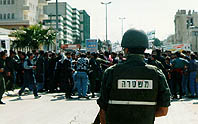
Above: An Israeli border guard surveys a Birzeit student demonstration, 1996. Photo by Yasser Darweesh. |
|
On the main road into our village, just before it arrives in the centre, you find the main mosque. Its minaret is very tall and its loudspeakers were very powerful. We used to use the mosque public address system to make announcements and to encourage demonstrators. During clashes a couple of young guys will stay there and shout things like, "Go on guys!" One day, the soldiers broke up the clashes really quickly. The soldiers began chasing us. As we reached the mosque and ran past it, I realised that the guys in the mosque hadn't realised that they were in danger and, in fact, Israeli soldiers were literally at the door! I remember thinking that they were really going to get fucked. One guy was left in there, still shouting, supposedly to encourage us to get the soldiers on the run! I turned around the corner and quickly shouted through the window, "Man! Man! The soldiers are at the door!" He leapt from the window, holding his shoes in his hand (as you aren't supposed to wear them in the mosque!) and looked at me in shock. At that moment a soldier ran round the corner, fifteen metres away. By the time we started running, the soldier was only three metres behind us. I could see his legs under my arms. He didn't have time to stop and shoot at us as he knew he would lose us in the time it took him to get ready, and you could tell he really wanted to catch us! What saved both of us was the house at the end of the T-junction we were running to. A bunch of the guys from the village were in the garden, and a hail of stones suddenly began to pour over our heads at the soldier chasing us behind. It later turned out that a huge number of soldiers had been chasing us! At the end of the T-junction, we both turned. I had been running on the left and the mosque guy on the right, and we - for some reason - ran across each others' paths down the two branches of the T-junction. We were lucky we didn't crash into each other. Now, that would have been the end! Once, during some Intifada clashes, three guys were very close to the soldiers, maybe a hundred metres away from them. The soldiers advanced until we were all driven back nearer to the village, which was as far as they could come. At these times things can happen very fast and things get confusing so, when all the movement stopped, we began checking amongst ourselves. The three guys were missing. That was it! They were gone, they had been killed. There had been so many shootings and injuries already, and so we were certain they were dead. We knew of course the names of the guys but we could not announce them until we were certain that they were dead, but we were pretty sure. What other explanation could there be? For sure they had been shot down. Half an hour later we hear an announcement on the radio, that three civillians had been killed in the village of Sealat Al-Hartheyah. Someone had phoned a radio station, perhaps a journalist who was working for it. "There are incredible demonstrations in Sealat Al-Hartheyah village today, and three already have been killed, and who knows how this will escalate...", that sort of thing. The best thing was that they had not announced the names otherwise their families would have died of fright. After a couple of hours, some guys prepared molotovs and began throwing them at the soldiers, who began to retreat back to the first point where they had been. Suddenly the three guys appeared! They had suddenly found themselves behind the soldiers lines. What can you do in this situation except hide?! They had not dared to do anything or to move until the soldiers had returned to where they had been before. "The radio has already broadcast that you are dead!" we told them, laughing. |
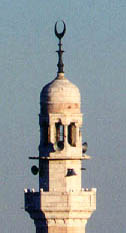
![]() Above: Mosque minaret with those ubiquitous and multipurpose loudspeakers, Ramallah, 1996. Photo by Nigel Parry. |
| The soldiers seemed really stupid at that time. Sometimes there were big demonstrations with, say, 300 or 400 people. Sometimes if they spotted someone who was very active in a particular demonstration they would shoot at him to kill or want to capture him. An order would go round the soldiers, get the guy with the red shirt or white shirt or whatever. When the demonstration would end, they would move around the streets looking around to get him. They would arrest everone fitting that description. |
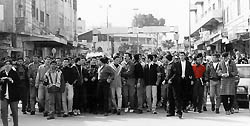
![]() 1997. Photo by Nigel Parry. |
|
Sometimes, you would just be walking around town and you didn't even know that there was a demonstration ten minutes ago, and you were wearing the 'magic' red shirt. Out of a thousand demonstrators, 100 of them would be wearing red shirts! And the soldiers in the area would carry out the order as if there was only one person in the whole world wearing a red shirt! As they detained more and more people with red shirts, they would begin arguing amongst themselves about who was the right one. It was ridiculous. One time before the Intifada, it was summer and I was wearing a white T-shirt with blue jeans. Most of the guys, to this day wear these clothes in the summer! After this particular demonstration, they began to arrest people with white T-shirts and blue jeans, even people who were shop keepers and were minding their own business! I had been in the demonstration and was afraid of being recognised because of my distinctive hair colour so I went to a clothes shop, did a deal with the shop-keeper, and part-exchanged the clothes I was wearing at half price for some black jeans and a black-and-white checkered shirt. I left the shop and was walking outside, strolling as if I hadn't a care in the world. I ended up standing right behind the soldiers and looking at what they were doing while they interrogated the unlucky guys for two hours. The funniest thing was that it wasn't luck that I had money in my pocket and had been able to escape. I had been on my way to buy clothes anyway, when I seen the demonstration start and joined in! It had only been a short detour! |