Intifada Diary: Ten Years After
December 1987 onwards
"'Odai: How we organised locally"
I went home to Hebron, and the primary concern in my mind at that time was to keep this thing alive. Only Hebron University students were actively taking part in the Intifada at that time, but the city of Hebron was not doing anything. Hebron University was closed on the 5th of January, 1988. Around the 10th, the city finally began to join in. Up until that time I was very busy. We had an emergency council of young leaders from different factions to force the city to move. We began to organise young people. They used to bring them to me to talk to and I would tell them, "There is nothing to talk about. The only thing we have to do now is to kick the Israelis out of our cities and do the same as all the other cities in Palestine."

We began to organise demonstrations, blocking the roads and throwing stones at the soldiers who came to break up the protests. The first leaflet was released by the underground Unified National Leadership of the Intifada (UNLI) on 8 January 1988, ordering local shop owners to strike until the evening of 13 January.

The Unified National Leadership started with Birzeit University students, later including academics and other professionsals. We needed people to think about what we were doing. With time we had sociologists, economists, psychologists, politicians, military strategists involved. The tone changed over time. The second one was much better than the first, and the third better than the second, and so on. Each one began to have an introduction about the political situation, what our goals were, activities and then orders and strike day notices.
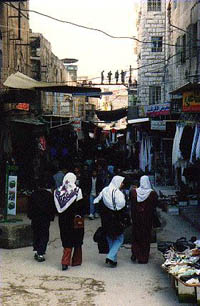
See caption below Israeli troops on catwalk above Hebron's Old City, 1996. Photo by Nigel Parry.
Anyway, the first leaflet instructed the merchants to shut their shops. Initially, the merchants of Hebron were unwilling to undertake commercial strikes and refused to close their doors. We were given orders by the leadership to force them to close.

There was a coordination between the leaders of youth factions at a local level and we decided how to implement the orders between us. This was very easy. I had a friend who was from Fatah, a neighbour of mine. We had been friends since childhood. Another friend was from the PPP, the communist party. We called each other, discussed things, and agreed to tell each others' people and got back to each other.

That night we went to the shops with tools and hammered nails with the heads removed into the keyholes of the padlocks that locked the shops. In the morning, we went down to the streets to see the reaction of the shopkeepers. They said to us, "Okay, if you are men, if you are really patriotic, you have to protect us when the Israeli soldiers come. Wait here."

Our orders were to impose the strike in any way and this seemed fine to us so we waited. We all knew that the soldiers would break open the shops to try to stop the protest. A friend of mine from Birzeit University, whose family lived in Hebron helped me. There were fifteen of us in total, young, old, any size or shape. We cared only that there was enough of us, to show we could do something. Of course, thirty hands throwing stones was much better than two.
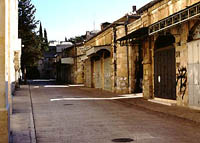
See caption below Commercial strike, Christian Quarter, Old City, Jerusalem, 1989. Photo by Nigel Parry.
The Israeli soldiers arrived and began telling the merchants to open their doors. The soldiers began to put hooks through the U-shaped padlocks, connected them by cable to their jeeps and pulled them open by force. We were waiting and we began to throw molotov cocktails at the soldiers and burnt a jeep. Then the guys started to throw stones. Then the merchants joined in. Then everybody in the streets started to throw stones. People were throwing stones from their windows and from the roofs of their houses. We had wanted to make a spark and here we were, seeing it catch fire.

After that, we began to increase our activities. We wanted to do everything, anywhere, at anytime. We started to threaten the collaborators in leaflets. I had an old typewriter. We were all basically improvising, with some consultation. The leadership entrusted us with the details. The leaflets said, "Do whatever is necessary: Attack Israeli vehicles, burn Israeli property, and boycott Israeli products. This is our chance to kick out the occupation," all those big slogans.
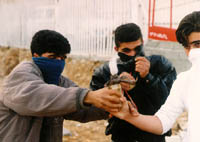
See caption below Demonstrators preparing molotov cocktails, Ramallah, 1997. Photo by Nigel Parry.
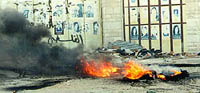
We wanted to give the impression that the Intifada was spreading all over Hebron to encourage others to join in, so we began to move around in cars, carrying petrol, old tyres, and all the necessary equipment to begin a demonstration. We burned tyres everywhere in the city - this intersection, that intersection - with five or six cars, in one or two hours we had all the city on fire. No one was necessarily manning these barricades, we were just trying to give the impression that it was going on every place, to encourage the people that the Intifada has reached this point even, in their neighbourhood. We used to throw stones at the Israeli settlers' buses that were driving inside the city and began to break the windows of settlers' cars. See caption below Burning tyres, Ramallah, 1996. Photo by Yasser Darweesh.


Home | Intifada Diary Index | Next entry: "Leaflets, the newspapers of the Intifada"


This page is part of the website "A Personal Diary of the Israeli Palestinian Conflict" by Nigel Parry. All photos and text are © Nigel Parry. More information about the diary can be found in the FAQ. Photos can be ordered. Reach Nigel Parry via the contact page. This website has frames to aid navigation. Get back to them here if you surfed into this page directly.