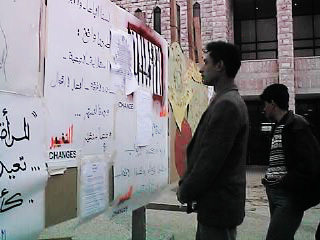
The student council elections at Birzeit University passed this year without the traditional journalistic hordes descending on the campus. Previously, the integrity of Birzeit's scrupulously transparent election process and its representative demographic mix of students made the university a focal point. In 1995, over 200 separate media organisations were registered during election day.
This year's change is a reflection of the feeling that the Palestinian Council elections have succeeded Birzeit's as a barometer of Palestinian attitudes, a fair enough assumption if one considers their national character and that candidates represented the actual, rather than student leadership.
Yet, the democratic nature of the Palestinian elections is very much in question in the minds of many Palestinians, unless of course you were one of the many non Arabic-speaking international observers paid - according to one source - around US $14,000 each to rubber stamp the domination of the status quo. Unequal time on television and in the media between Fatah and independent candidates, Israeli intimidation at East Jerusalem polling stations, various ballot boxes mysteriously appearing and disappearing and, most significantly, the almost total absense of real opposition candidates.
This year, as always, Birzeit's elections included blocs representing Fatah, Islamic students, independent, and pro-PFLP, -DFLP and -PPP tendencies. Rumours have it that Fatah's Shabiba bloc spent more than US $10,000 on their campaign compared with the pro-PFLP bloc's 2.7 and the PPP's 0.7 percent of this figure. The campaigns were more focused on national issues than last year, largely due to recent Palestinian Authority (PA) measures against students and educational institutions - the violence at An-Najah, PA's detention of pro-Islamic students and a destructive raid on the Islamic University of Gaza.
The coming of the PA has also seen a large number of the Fatah activists drawn in to work for the authority, some estimates putting the number of students on campus working for the Palestinian Preventative Security Service (PSS) or other plain-clothed forces at 20 percent. Outgoing Fatah president Ibrahim Khreishi irked the authority by leading a series of demonstrations against the PA measures that culminated in a confrontation with Arafat himself, outside the PA's Ramallah Headquarters on 3 April. This year's Fatah bloc leader, accused during the election campaign of working for the PSS, led a boycott against the 3 April demonstration. This precipitated a large split in Fatah. As elections approached, sources reported that the PA, anticipating a Fatah defeat, would have preferred the Birzeit vote to have been delayed until after the Israeli-Palestinian negotiations had begun.
The results did not surprise. The pro-PFLP, -PFLP and -PPP blocs mostly held on to their seats in the 51 seat student parliament, with only the PFLP losing a seat. Meanwhile Fatah was rocked by a 32 percent result from 748 votes compared to last year's 40 percent, while the Islamic bloc soared with 1,005 votes from last year's 34 percent to 43 percent. This was not newsworthy? With growing dissatisfaction with the PA intelligence role in Palestinian society, I suspect that the Birzeit result represents a significant omen of a coming conflict that Arafat and the PA would be wiser not to ignore.
This article first appeared in Middle East International