|
A few days before the Christmas break, the students got fed up, as the clashes had spread all over the country and we were still not involved. Every village, every refugee camp, every place, every inch of Palestine was on fire and the number of deaths was raising every day. We said, "Fuck it. We're going to do something. We have to do something. We can't just wait until they kill all the people." So, I remember, that students from all the universities came down to the old campus of Birzeit University for a gathering outside the General Assembly hall, in the courtyard. Lots of employees, teachers and professors were there and, as an estimation, not less than 80 percent of the students. |
|
We declared that we wanted to hold a demonstration and we went out into the streets of
Birzeit town to start blocking them with barricades, with stones, with tyres, with anything. We started to prepare molotov cocktails, collecting petrol and volatile stuff. The barricades went from the old campus all the way to the womens' dormitories at the entrance of the town - made out of old cars, garbage bins, any available metal or stone - one kilometer of barricades. The soldiers did not show up the first day. At around eight o'clock in the evening, we declared Birzeit as an "independent zone", as a "free zone" from occupation. Radio Monte Carlo held an interview with Yasser Arafat that night, in which the interviewer asked him, "The students of Birzeit University have declared Birzeit town as a "free zone". What do you think of that?" Arafat replied, "This is a very heroic initiative by our students. We hope that all other universities and cities will follow suit." I remember that everyone was happy and shouting on the streets. |
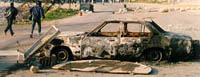
Burnt-out car used as demonstration barricade, Ramallah 1997. Photo by Nigel Parry.
|
|
We slept by the barricades that night. I was responsible for a kawwat ad-darrabi ("strike force"), a cell of five people responsible for patrolling an area. These underground units became very important during the Intifada. The second day, in the morning, there were hundreds of journalists in Birzeit town, waiting for the clashes, but the Israelis still did not show up. There were hundreds of students by the barricades. We were distributing food. It was like an army. Around noon time, some students called the Military Goverernate of Ramallah, and told them, "You! Bastards! We are calling from Birzeit. We have declared the town a 'free zone' and it is the first in Palestine. We have been waiting for your cowardly dogs [the Israeli occupation soldiers] to come over. We are not going to send anyone to you. You will have to go to the trouble yourself. Send your dogs!" The Militory Governor sent two jeeps, that remained about five kilometers away from us. They did not come near us. The atmosphere was like the Paris commune, it was amazing. All the men and women, all the students were sleeping out in the streets. We had speakers hung everywhere in the streets, connected by wires so we could listen to the news, minute by minute. |
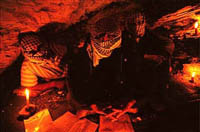
Underground Palestinian activists hiding in a West Bank cave. Photo by George Azar, 1991, from his excellent book Palestine: A Photographic Journey. Check out the Intifada Diary index for information on how to order the book.
|
|
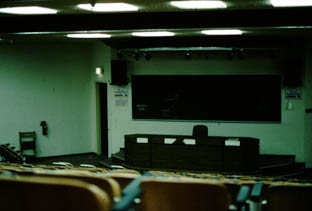
Families were worried about their kids. They wanted to come but we had checkpoints and didn't allow them. We wanted to die and we wanted to have a battle until the end! Every half hour there were reports of clashes all over Palestine. The next thing we heard in the, news after we had issued the confrontation to the Ramallah Governate, was that Birzeit University had been closed by military order for three months. The soldiers never came. In the evening of the next day, we heard speeches from the leaders of the student politcal factions, who asked us to return home the next morning and to keep alive what we had begun to call the 'Intifada'. The word had caught on just like that. It is an Arabic word that derives from "shaking", with the connotation of rejection of the situation. It was the first time that we had witnessed clashes in every part of Palestine, even in Jerusalem and inside the Green Line. It meant that we were shaking off the shackles of occupation. The speakers were encouraging us to return home to our own towns and villages and not just to live normal lives. That this was a time of testing, a chance to get the occupation out. "Now," they said, "it is your turn to educate the people in how to organise the Intifada. Each one of you should be an ambassador, a patriotic ambassador in your town or village." We didn't want the Intifada to just be random. They concluded by reissuing our declaration that Birzeit was a free zone. We parted the next day, saying goodbye to each other. We didn't suspect at the time that the next time we would see the university open would be in April 1992. |
Above: Empty Birzeit University lecture hall, 1989. Photo by Nigel Parry.
|