Palestinian Authority Diary
9 February 1998
"Iraq, Palestine, and chemical and biological war"
 Why not listen to some music while you read? This entry's offering, "Ah Pook the Destroyer/Brion Gyson's All-Purpose Bedtime Story", spoken poetry by William S. Burroughs (PBUH) over music by John Cale, from Burrough's 1991 album "Dead City Radio". You'll need the free Real Audio player and you can shift-click in Netscape to download the 361K file from here to play from your hard disk if you experience any network congestion. Parental Advisory suggested. Click on the note to begin.
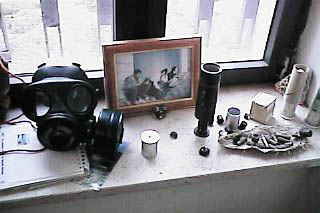
Left: My office window with rubber and live bullets, teargas cannisters and other debris from the various clashes of the last two years - September 1996, Abu Ghnaim and others. Far left is a gas mask left over from the 1991 Gulf War which one of our office workers shrewdly brought in after we got teargassed really badly while covering clashes in early 1997 (pictured).
Hype, hype, hype
With all the hype, hype, hype to prepare us to bomb Saddam to oblivion, as if he was the only Iraqi who is going to die in the seemingly inevitable sequel to the Gulf War, one is tempted to forget the cost of the last war.
Israeli government TV has been replaying the documentaries made at the time of the first war, showing endless scenes of terrified Israeli standing in shelters with gas masks on. It's the victim game again, played on a rather primal playing field for the children of the Holocaust reality: Jews...gas...Saddam Hussein...Hitler. The connection was made more than once in a Hebrew language documentary I watched the other day.
"Saddam is the new Hitler!" screamed one man. The subtlety of these motivations and other impulses were perhaps best captured by the headline on page 3 of today's Jerusalem Post, "German government sending 180,000 gas masks soon." Such cringe-inducing symbols and gestures and all contrived to make you as relieved as hell when the B-52s head over to Iraq for some more carpet bombing of Baghdad.
And surely everyone knows that if even one chemical or biological missile even poked its nose over our way, Israel and the US would ensure that Iraq would cease to exist within, say, 15 minutes. Albert Aghazarian, director of the Public Relations office at Birzeit, reckons that "If Saddam even sent the whiff of onion over here, Israel would carpet bomb Baghdad, and if Saddam sent the smell of garlic over here, they would drop a hydrogen bomb on Iraq." So, is there really any "threat"?
The Threat
I was living in London at the time of the first "war", if you can call it that. A "war" in which a handful - something like 140 - of allied soldiers died (a significant number of whom were victims of "friendly fire") compared with over 200,000 Iraqis, over half of whom were civilians.
In the forty-five days of the Gulf War over 56,133 tonnes of bombs were dropped on Iraq -- exceeding the 47,777 tonnes dropped in the Second World War.
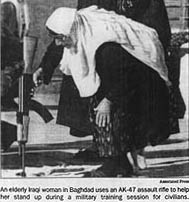
As a direct result of the sanctions on Iraq since that time, promoted most strongly by the US and Britain, two countries who long opposed sanctions on Apartheid South Africa, almost 1 million Iraqi children have died.
As Israelis like playing the numbers game, it seems more than appropriate to remind ourselves that this is the same number of children that died in the Holocaust.
And now after seven years of sanctions, we're thinking about bombing the country again. A 1997 UNICEF report stated that another million children under the age of five are suffering from severe malnutrition. The Iraqi people are in a bad way.
Asked on the US television programme "60 Minutes" on 12 May 1996 whether the cost of the lives of over half a million children "was worth it" in order to get rid of Iraq's President (assuming the former was necessary to achive the goal), Secretary of State Madeleine Albright (then US Ambassador to the UN) replied that "it is a hard choice, but the price -- we think the price is worth it."
More recently, Albright said that the coming strike against Iraq would be "substantial" and that "There are those people who have said, 'is it going to be a pinprick?' The answer is a resounding 'No'."
Similarly, US Defence Secretary William Cohen promised Israeli defence minister Yitzhak Mordechai yesterday that the action against Iraq would be "extremely harsh".
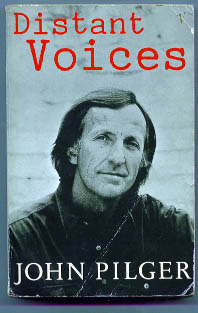
Is it only me that thinks all this a little bit sick? Fortunately no. The definitive Gulf War analysis must be that found in the "Mythmakers of the Gulf War" section of John Pilger's book Distant Voices. A must-buy-right-now- instead-of-sitting-in-front-of-the-computer-type book no less. Unfortunately and unsurprisingly, it is out of print, but you might be able to get a used copy here or, if you're lucky, from your local bookstore. And the US-based Iraq Action Coalition and Voices of the Wilderness have been sending excellent e-mail updates. To subscribe to both, click here.
Palestinian support
These days the Palestinians aren't as misinformed (as they were in 1991) to believe that Saddam is going to liberate Palestine by firing a few SCUDs at Tel Aviv. But they have been made very aware of the suffering of the Iraqi people over these last seven years.
Demonstrations are supposed to be happening in all the major Palestinian cities today, in support of the Iraqis. The demonstrations are all factionally-organised, at the instigation of the Fatah-controlled (Arafat's faction) Palestinian Authority and it is raining today, so I don't expect them to be particularly large, although I'm sure that a few shebab will want to got to the edge of Bethlehem and throw a couple of stones at the Israelis.
Here we go - a friend just passed by to tell me that about 200 Fatah youth turned up in Ramallah, some went to the edge of the town to confront the Israelis and one was injured with a rubber-coated metal bullet. TV here obviously hasn't been so good recently.
What does your average Palestinian think about it all? Most seem to think of it on a Palestinian level of "Well, the US and Israel are against Iraq, so obviously the Iraqis can't be that bad." They know the US hype is a sham. One friend pragmatically commented recently: "Saddam should go if he cares about his people, otherwise the sanctions will never stop. The issue has become one concerning the survival of the Iraqi people."
Seems to me that the issue is becoming one of the survival of Bill Clinton's presidency. Nothing like a war to help the country forget that he can't keep his pants on for five minutes.
So anyway, in the middle of all the propaganda and talk surrounding the current build up for war, one Jewish correspondent to the diary asking what plans the Palestinian Authority had for distributing gas masks. It was a fair point. Can't hurt to ask, I thought, any sensible government would make provisions. Here's the answer I received, reproduced without comment:
Date: Mon, 09 Feb 1998 10:57:26 +0200
From: Palestinian National Authority Official Website
Organization: Ministry of Planning and International Cooperation
To: Birzeit Webmaster
Subject: Re: gas masks?
Birzeit Webmaster wrote:
>
> Hi PNA,
>
> It just occured to me...
>
> Does the PA have any provisions for Gas Masks for the local
> population under PA control, as a result of a chemical or
> biological SCUDs arriving from Iraq?
>
> Thanks for your speedy response,
>
> Nigel Parry
> Birzeit Webmaster
Dear Nigel,
This is a tough question, and I am not sure if the PNA has
plans to distribute gas masks. However, the Palestinian
population is always finding ways to compensate for the lack
of sophisticated gas masks by producing a local gas mask
(coal and a piece of cloth will do quite admirably as I have
heard!!!). Best wishes from Palestine.
M.K.A.

Home | Palestinian Authority Diary Index | Next entry: "Who killed Muhyideen Al-Shareef?" [4 parts]
This page is part of the website "A Personal Diary of the Israeli Palestinian Conflict" by Nigel Parry. All photos and text are © Nigel Parry. More information about the diary can be found in the FAQ. Photos can be ordered. Reach Nigel Parry via the contact page. This website has frames to aid navigation. Get back to them here if you surfed into this page directly.