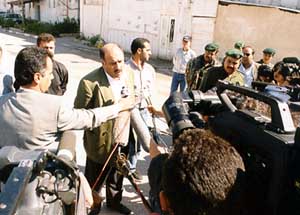
At the initial press conference on 6 April (left) announcing Hamas involvement in Shareef's death, PSS head Rajoub stated that a "senior Hamas leader" had been allowed to hear Ghassan Addassi's confession. According to a variety of accounts from inside the prison, this person was Mahmoud Musleh, himself imprisoned in Ramallah by the PA since last August. Musleh apparently went in alone to see Ghassan at Ghassan's request and heard his story. Ghassan denied having done anything and claimed that he was being tortured to get him "to admit to things I haven't done."
The story continues that Musleh charged him to continue to tell the truth and stick to his story, bade him farewell, and came out to tell Rajoub that the accusations were not credible and that, as far as he was concerned, Ghassan clearly had nothing to do with the case. Musleh was put into solitary confinement for ten days before being transferred to a PSS prison in Jericho.
A recent Hamas leaflet reproducing a letter allegedly smuggled from Ghassan Addassi in prison confirmed previous reports from other activists who were detained in the same prison and later released, that Addassi's torture included prolonged hanging from the ceiling, and additionally reported severe beatings and sleep deprivation. One friend of Addassi said that the distinctive style of the letter confirms it is his work. In the letter, Addassi explains why he 'confessed' to Palestinian Legislative Council member Hatem Abdel Qader, the second person brought in to bolster PA claims about him after Musleh sided with Addassi's version.
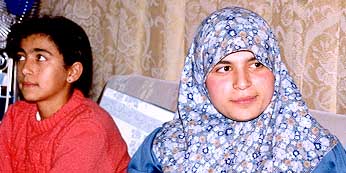
"Jibril Rajoub talked to me before the visit took place. He told me that my sister is arrested also and he threatened that they would [sexually] violate her if I told Hatem Abdel Qader that I had been tortured or threatened. They asked me to say that I had voluntarily confessed and this is the story I told Hatem Abdel Qader. I swear before God that I wouldn't do this if I wasn't afraid for my innocent sister and for her purity." 18-year-old Suzanne Addassi (right in picture) had indeed been arrested and had managed to see Addassi briefly in prison shortly before this incident. Ghassan's letter says he did not know that she had been released at this point.
Writing in Ha'aretz on 14 April, Israeli journalist Danny Rubinstein dismissed the letter as a "forgery", commenting that, "Incidentally, Adassi's sister was never arrested"
"They arrested me on 5 April, Sunday, at about 9:30 at night," reported Suzanne Addassi, "They brought two women from Preventive Security to take me. My father refused to let them take me and so they said that he could come with me. So my father came with me and they took us to the Preventive Security headquarters in Ramallah. They put me in a small interrogation room, accompanied by the two women who had brought me there and another man. Then they brought an interrogator. I remember his name being Mohammad Jibrin."
Rubinstein has published a number of articles about the case in Ha'aretz, including an early guess, "It was probably an accident" (3 April) and a later spoon-feeding, "Engineer or Banker?" (21 April) in which he offers the PA version of events as reality describing it as "uncovered" and not "reported". In addition Rubinstein ascribes a variety of glowing adjectives and phrases to the PA investigators, praising their openness:
In charge of the investigation were Arafat bureau chief Taib Abed Al Rahim and the head of the Palestinian security forces Jibril Rajoub, both of whom have recently made detailed announcements concerning the investigations and its implications. Abed Al Rahim, appearing live on Palestinian radio, gave precise answers to listeners' questions, including ones about the Adassi family (the central witness in the affair) and the victim's family. Rajoub granted a long interview to the Al Halij newspaper (which appears in the Gulf), and from these two announcements, a fairly clear picture of the affair emerges.
After her interrogation, when Suzanne had seen Ghassan for the first time, she recounted to me that Jibril Rajoub had told her she could visit Ghassan a second time to bring him a change of clothes.
"During that meeting, I asked Ghassan 'Why haven't you combed your hair. You look like you've lost weight.' The interrogator said 'No. Ghassan doesn't get any food. We don't feed him.' Ghassan tried to start telling me about what was happening to him but the interrogator stopped him, saying 'Ghassan, no. Let's keep this a social visit. Don't start talking about your interrogation as politics. Don't start talking politics. Just ask her how she is, how the family is and that's it.' I stayed with him for about an hour just asking how he was, and him asking how the family was. He wanted to tell me other things at the time, but the interrogator kept stopping him."
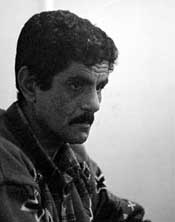
"The methods of torture that they were using on Ghassan were criminal," said Abdul Salam (right), his father, "They are hanging him by his hands from the ceiling. They didn't want anyone to see this. I've never heard of anyone hanging someone by his hands from the ceiling!" Detainees, now released, reported that they once saw Ghassan, unable to walk, being carried from the interrogation room to his cell by PSS men.
"They are interrogating without a system," continued Abdul Salaam, "They are working in utter chaos. They hit and hit and they don't know how to hit. They interrogate and interrogate without knowing how to interrogate. They torture without knowing how to torture. And without any reason. They don't have the proper system, methods or experience to get the information from the detainee without using this. All they understand is hit and break and then get the information. How is he supposed to answer you if he is broken?"
The rest of 19-year-old Addassi's letter is a pitiful declaration of his innocence and suffering during torture. "Here I am today, announcing my innocence in front of my people and my brothers in Hamas in order for them to know that I didn't betray them, but that what I have been through is greater than I can withstand. The prophet, God's praise and peace be upon him, allowed Ammar Ibn Yasser to curse him when he was under torture [a reference to a story in the Hadeeth]. I myself am no stronger in faith than Ammar Ibn Yasser."
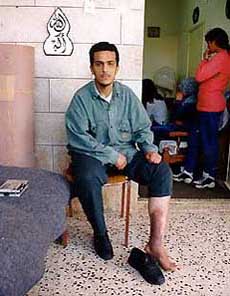
When I visited the Addassi family, Ghassan's brother Suffiyan showed me severe and extensive week-old bruises on his leg (left) that he says were a legacy from his own experiences of the PSS. "I consider this healed," he said, "You should have seen it a week ago."
Interrogators made him stand with his legs spread-eagled, then proceeded to kick the inside leg apart with military boots until they would go no further. "You play sports?" one joked. According to Suffiyan, this was not the worst part of the torture.
"Throughout our whole experience at the Preventative Security, we were being forced to confess to things that we knew nothing about. The same four questions: What is our relationship to Muhyideen Al Shareef; that we rented the garage to him; that we knew about the operation; and that we are all members of Izedeen Al Qassam Brigades. They threatened to charge us with collaboration if we didn't confess to these things. They arrested me and my brother Sultan on Wednesday at 6am. We stayed there until Tuesday at 11pm. We were in Preventative Security the whole time in solitary confinement. They also arrested me on the night of the explosion."
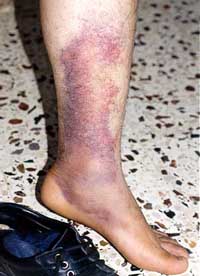
"Most of the interrogation was the same questions. Apart from what they did to my leg, they used shabeh (position abuse), raising my hands above my head for prolonged periods of time, making me stand on one foot for six hour periods. Every time I tried to lower my hands or legs when I got tired, I was hit in the neck or the face. Every six hours it was the same thing. When they weren't interrogating me I was in Shabeh in the solitary confinement cells."
"I talked to Ghassan while I was there," continued Suffiyan, "because he was put in the cell beside me. I asked him how he was and he said "Praise be to God, I am alright". I asked what had happened to him and he said that he had done nothing but they want me to confess to things that he hadn't done, things like collaboration. He also said that they had been hitting him very hard on his neck. One of the Preventative Security guards heard us speaking and came immediately and took Ghassan and I out of the cells. I didn't hear or see him after that. That was on the day of the burial of Al-Shareef, on Thursday. Thursday was the last day that anyone heard from him. We had heard some rumours that they had sent him to Jericho for interrogation, but they weren't true, but some people saw him inside. When I heard that I was terrified and thought that was the end of Ghassan, they will kill him. But there were prisoners who were in with him that assured us that he was still in Ramallah."
"The PA is not allowing any visits," says his father Abdel Salam, "so that no information can be given by Ghassan to us about what is happening so that we won't tell the community what is happening to him, the torture that they are putting him through, so that their own plans will work. They threatened Ghassan that 'we are going to charge you with collaboration', 'we will imprison you indefinitely', 'we will arrest all of your brothers', 'we will arrest your uncles', 'we will spread vicious rumors about you and your family'. My son is 19 years old. He has never been arrested, he has never been in prison. He is so young. With these techniques and through torture, he gave them information that was not true."
Suffiyan shrugs his shoulders, "I was thinking after all this, after losing everything, my work shop, everything, and when they tried to make me confess to things that I hadn't done! I'm thinking, 'You guys aren't right!'"
"Lots of journalists have come, mostly foreign and from Israeli TV. No Palestinian journalists have come. Its not that they can't reach us, its that they don't have the freedom to write anything."