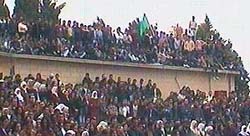
The 1999 Birzeit Student Council elections that took place on 24 March skipped a beat in a previously unbroken four-year seesaw pattern, of percentage - but not overall - victories, between the two biggest streams in Palestinian politics, the Islamic and Fatah movements. In 1995, Fatah won followed by an Islamic victory in 1996. In 1997, Fatah won again and in 1998, the Islamic movement again recovered the lost ground.
This year the Islamic faction triumphed with 23 seats out of a student parliament of 51, left 19 seats for Fatah, and nine for the left wing coalition. The only break from tradition in these elections was the appearance of a new Islamic coalition formed from the preexisting main Islamic group on campus, the Islamic Bloc, and the much smaller Bloc of the Martyr Fathi Shiqaqi.
The new Islamic coalition, An-Nahda ("The Awakening") by no means fits the media's "fundamentalist Islamic group" cliché. Although politically the bloc broadly supports the prevailing militant Islamic attitude in the Middle East towards the Israeli occupation, on social issues it is singing a very different song to that evident in the dealings of the Taliban in Afghanistan.
"There is no place in our beliefs for preventing women from working or participation in political or social activities," stated the Nahda representative in an interview on the Birzeit University elections website [at http://www.birzeit.edu/scouncil/elections/1999 - the most comprehensive election site by Birzeit ever]. "On the contrary, we encourage woman as a human being to take her role courageously and effectively, as can be seen from our activities on campus and the participation of female students in them."
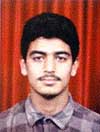
Once again, the Fatah faction on campus tried to fend off accusations of ties with the security forces, appealing during the 23 March debate, the traditional center piece of the Birzeit elections, for the Palestinian Authority to release student Ghassan Addassi (pictured left), an Islamic Bloc member detained for almost exactly a year on clearly trumped-up charges of assassinating one of the leaders of the military wing of Hamas.
Such protestations fall on deaf ears in the current climate, where post-Wye accord arrests of Islamic activists by the PA continue in tandem with similar arrests by the Israelis, presumably coordinated by the CIA in its new role as official 'peace process monitor' of the fight against terrorism.
In March alone, Israeli military authorities in the West Bank arrested ten Birzeit University students, almost exclusively from the student Islamic factions, bringing the number of students detained to a total of fifty-five, seventeen of which were arrested since the beginning of the year.
On 9 March, Israeli security police stopped a student bus en route to the university. All female passengers were ordered off the bus, which was ordered to proceed to the nearby settler bypass road, where two students were taken away. The bus was then ordered to Ramallah, preventing the remaining students from attending university.
The Birzeit Student Council President, Iyad Habib Mohammad, has been held in detention by the Israeli military authorities since 26 January, denied access to his lawyer via a series of renewable Israeli prevention orders.
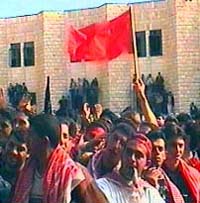
Birzeit's elections, although conducted in an unimpeachably democratic atmosphere, are very much a product of these external influences. Following massive and arbitrary Palestinian Authority (PA) arrests of Islamic activists in the wake of the four Spring 1996 bus bombings, the Islamic Bloc gained over 10 percentile points to secure 23 seats in the student council against Fatah's 17.
Last year's elections occurred in a similar atmosphere of repression against Islamic activists, with three students languishing in PA detention without charge or trial, and the presence of Fatah-affiliated students working with or for the security forces.
On the day following the 1998 election, leaders in the Islamic Bloc noticed that the head of the Bloc was being watched. Just before he left the campus, two students were observed making a call from a public phone on campus. They were overheard describing the type, colour, and the license plate number of the car and the direction it was taking.
As he left the campus, he was stopped and arrested by members of the Palestinian Preventative Security (PSS) Service. Taken to PSS headquarters in Ramallah, he was interrogated personally by Jibril Rajoub (right), West Bank head of the PSS. The majority of Rajoub's questions revolved around the elections and his disbelief of "how the Islamic Bloc could have won." The student was released the following day.
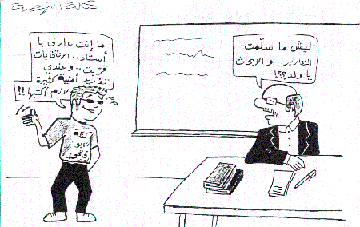
The bitterness of student election campaign materials clearly reflects the growing alienation between the Islamic and Fatah factions in the wider Palestinian society. This year, one Islamic charactature (pictured right) depicted a Fatah student excusing himself from handing in a class report by explaining to his lecturer, "You know, teacher, the elections are coming and we have to write many security reports."
Perhaps the final word should go to the left-wing coalition, who maintained their proportion of the vote this year. The Progressive Democratic Student Pole ("Qutob"), focused on the question of Palestinian identity in their campaign materials.
"In this [current] state of uncertainty and confusion, as the gap between the dream and its realisation widens," reads its manifesto, "we should become aware of our dismantled identity and realise what dangers surround us. It's time that we wake up and work on achieving our dream. For the Palestinian people are torn between different parts of the world. We must move now, before we lose our sense of belonging and identity. Otherwise, we will have nothing left but this sense of alienation."
Note: Election images on this page were provided courtesy of Birzeit University.